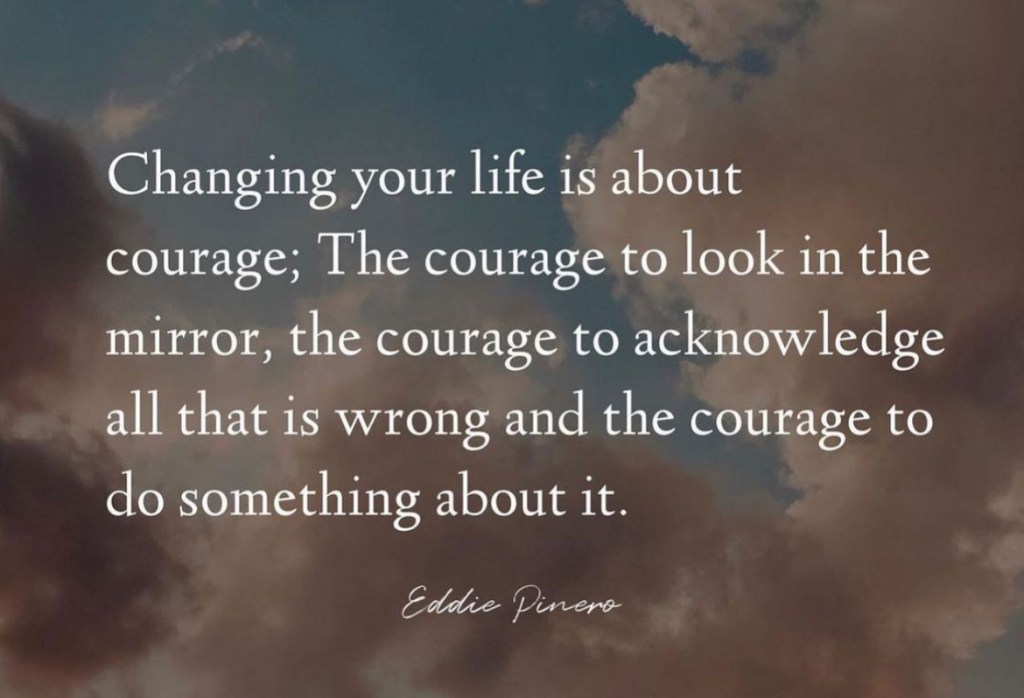
It’s been one year since I made the decision to give up drinking. On January 1, 2023, I set a goal to make it 50 to 100 days without alcohol. Tomorrow, January 1, 2024, will be day 365…
Habits. We all have them.
James Clear, author of Atomic Habits, says that “habits are reliable solutions to recurring problems in our environment.” Feeling stressed? You might attempt to solve that problem by going for a run, smoking a cigarette, having a drink, or buying something you can’t really afford. Behaviors, like these, are ways for us to change our internal state; to feel better. What happens over time, is that these behaviors become habits and our habits shape our identity.
Habits either work for us or against us. The biggest problem with habits is that as adults, we “rarely notice the habits that are running our lives.” After a while, we unconsciously slip into certain patterns of thinking and acting.
Picture yourself driving down a dirt road or on a sandy beach. Your car tires slip into the deep grooves formed by other vehicles driving the same route. When you turn the steering wheel, your vehicle struggles to get up and out of the groove to carve a new path. If you only turn the wheel slightly, chances are the car will fall right back into those ruts. It’s easier to stay on the path. Trying to steer any other way is hard. It requires effort.
That’s the same with habits. If you are someone who has formed a positive habit, like exercising, those grooves serve you well. You work out consistently because it’s become a habit. It’s become a part of your lifestyle. It’s become a part of your identity. It would be harder for you to not workout because you’ve laid the groundwork over time. The ruts are there. They keep you on the right path.
Habits don’t always work in our best interest though. We can carry on with certain behaviors without realizing the impact it has on us or those around us. Once habits become automatic, we usually stop paying attention to our behaviors. If we don’t take the time to self-reflect or as my mother says, “take an inventory of ourselves”, those metaphorical grooves get deeper and deeper.
I started to feel the impacts of my own habits in late 2021, when the world was still navigating a global pandemic. The year prior to COVID-19, I became a foster parent to a 2.9 year old. Flashback to a couple of years before that, my dad died unexpectedly at age 63. My father and I had a complicated relationship mired by a gambling addiction, so the grief I experienced as a result of his death was messy, to say the least. After his death, I found ways to detach from those complex feelings of grief altogether. It was easier to stay mad at my dad than try to unpack years of disappointment and hurt that his addiction caused me and my family. A lot happened in a short amount of time that caused me to feel overwhelming emotions. Drinking became my go-to solution for my problems. Without me consciously knowing it, drinking had become my habit.
In late 2021 into early 2022, I began to realize just how unhappy I was with the person I had become. I found myself asking the question, “if you don’t like who you are, Alyssa, then who do you want to be?” For the rest of 2022, that question guided my every step. I began the new year by identifying my personal values and principles. Then, I started to make small but radical changes that aligned to my values. I made deliberate decisions and took decisive action. I made exercise a priority again. I quit drinking for the months of January and July. I meditated and did yoga. I stopped bringing work home with me. I made family time a priority. I read books and learned more about addiction and as a result, I forgave my dad. I journaled more and wrote poetry. I unfollowed toxic people online and stayed away from negative people in real life. I went back to church. I spent more time in nature. I made it so that my entire algorithm on Instagram changed so I was no longer inundated with divisiveness and negativity. I stopped watching the news, and I only read it when I feel emotionally prepared to consume it. I planted seeds in the soil and we grew a luscious garden. I listened to podcasts by people who motivate and inspire me, like Adam Grant, Mel Robbins, Jay Shetty, Lewis Howes, Oprah, Ed Mylett, among many others. By the end of 2022, I no longer needed alcohol to solve my problems and I was ready to give it up. I set a high-low goal of 50 to 100 days. December 31, 2022 was the last time I had a drink. Today, is day 365.
There’s a simple saying that “nothing changes if nothing changes”. We will continue to live our lives on autopilot and continue with our habits until they become who we are, whether we consciously made that choice.
As James Clear points out, our identity is our repeated “beingness”. The choices we make and the actions we take are what form our identity. Contrary to what some may believe, our identity is not fixed. It can be changed. As humans, we are made to evolve. The thought of changing our identity or forming a new identity might sound daunting, but it really doesn’t have to be. What it does require, though, is a level of self-awareness, introspection and honesty. For me personally, it also required therapy. I had a lot to unpack from my childhood to fully understand my own actions and behaviors. This might be the case for you, too.
In my opinion, the first place to start is taking time to reflect on your core principles and values. Just like our identity, our values and principles can change over time. But remember, in order to change who you are, you have to decide the kind of person you want to be. Once you’ve decided, you have to take meaningful action that aligns with the person you want to become. Start small, but start somewhere. Lastly, be patient with yourself because all of this takes time. It takes effort. But it will be worth it.

 Words by A.Chase
Leave a comment